Cecilia Yip1, Steven Wyler1, Syann Lee1, Adrian Rothenfluh2, Young-Jai You1, Joel Elmquist1
- Department of Internal Medicine, Hypothalamic Research Center, University of Texas, Southwestern Medical Center
- Department of Human Genetics, Division of Adult Psychiatry, University of Utah
Abstract
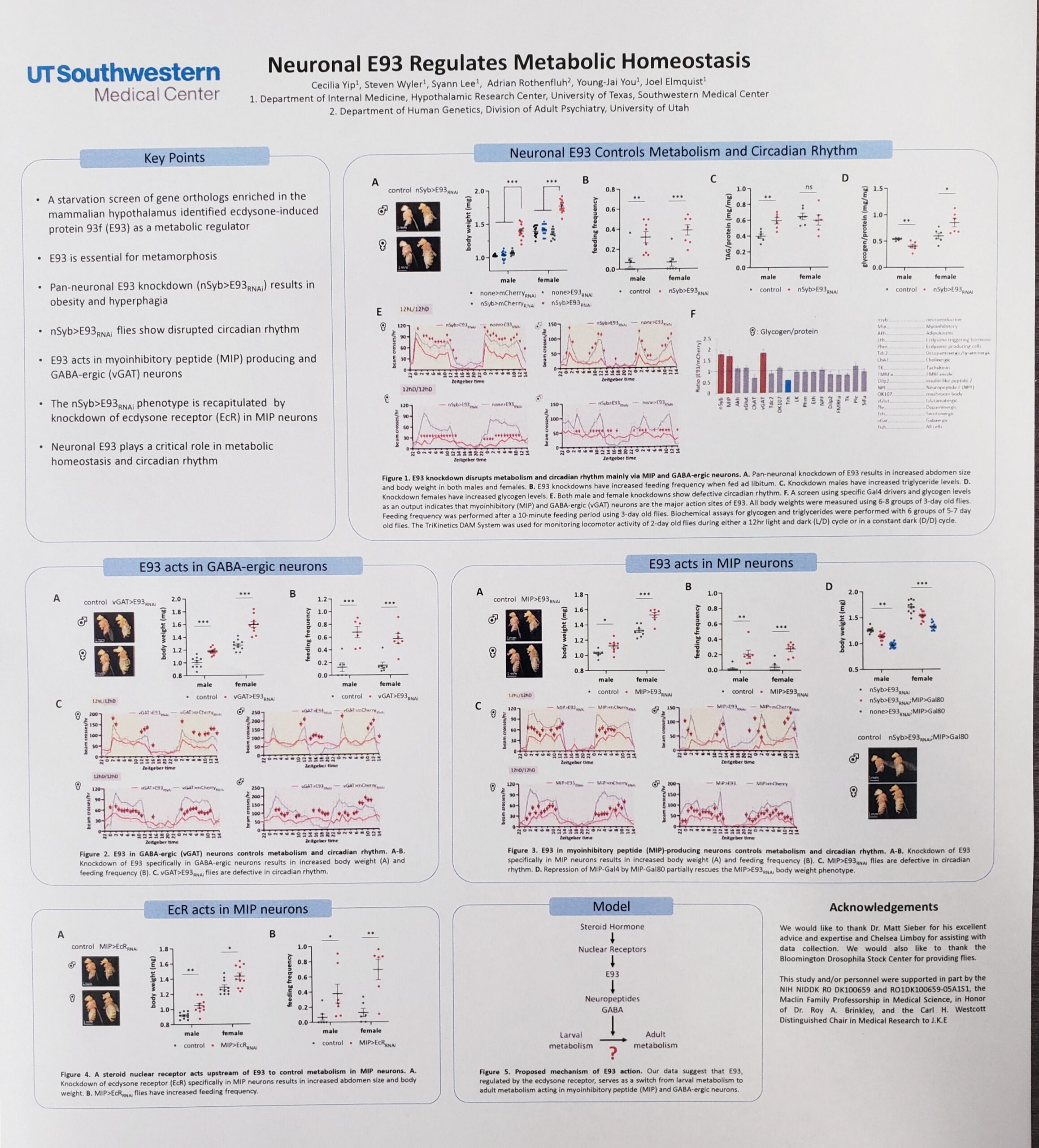
The central nervous system integrates environmental and internal cues to drive physiological and behavioral responses to control energy homeostasis. E93 plays an essential role during metamorphosis, yet its neuronal function in adults has not been fully understood.
To determine the central role of E93, we knocked down E93 expression using nSyb-Gal4 (nSyb>E93RNAi), a pan-neuronal driver. Unlike whole-body knockout flies, which cannot progress to eclosion, the nSyb>E93RNAi flies became adults. The nSyb>E93RNAi adults are obese and hyperphagic, with increased energy stores, revealing a novel role of E93 in metabolism. Assessments of whole-body glucose, glycogen, and triglyceride levels indicated a sexual dimorphism in their fuel stores, with males having increased triglyceride stores while virgin females show increased glycogen stores. In order to identify the sites of E93 action, we targeted E93 RNAi in subsets of neurons using 17 Gal4 lines. We found that E93 knockdown specifically in myoinhibitory peptide (MIP) producing neurons and GABA-ergic neurons mimics the phenotypes of nSyb>E93RNAi. Repression of the Gal4 driver by Gal80, specifically in MIP neurons, partially yet significantly rescues the E93 phenotypes, confirming the role of E93 in MIP neurons. Knockdown of the ecdysone receptor (EcR), the known upstream signaling molecule of E93 specifically in MIP neurons phenocopies the E93 phenotypes, suggesting that steroid hormone signaling to E93 in MIP neurons regulates metabolism. Metabolic dysregulation is often associated with abnormal circadian rhythm. Indeed, nSyb>E93RNAi exhibits a disrupted circadian rhythm; both males and females show reduced activity during the day and decreased day time period.
Together, our study reveals an important neuronal function for E93 in controlling metabolism and provides an insight into how a transcriptional network downstream of a steroid hormone regulates metabolism and circadian rhythm.